Aligning Impact & Intent: Reflecting on Product Metrics, KPIs, and OKRs
As product creators, we’re constantly looking for ways to bridge the gap between abstract strategic goals and tangible user value. When leading UI/UX initiatives or conducting deep-dive app audits, one challenge comes up time and after time: how do we construct meaningful metrics from scratch?
It’s one thing to audit an application for usability or visual consistency, but it’s another to translate those insights into measurable business value. Knowing which numbers actually reflect product health—and which ones are just noise—is essential to making design and production decisions that stick.
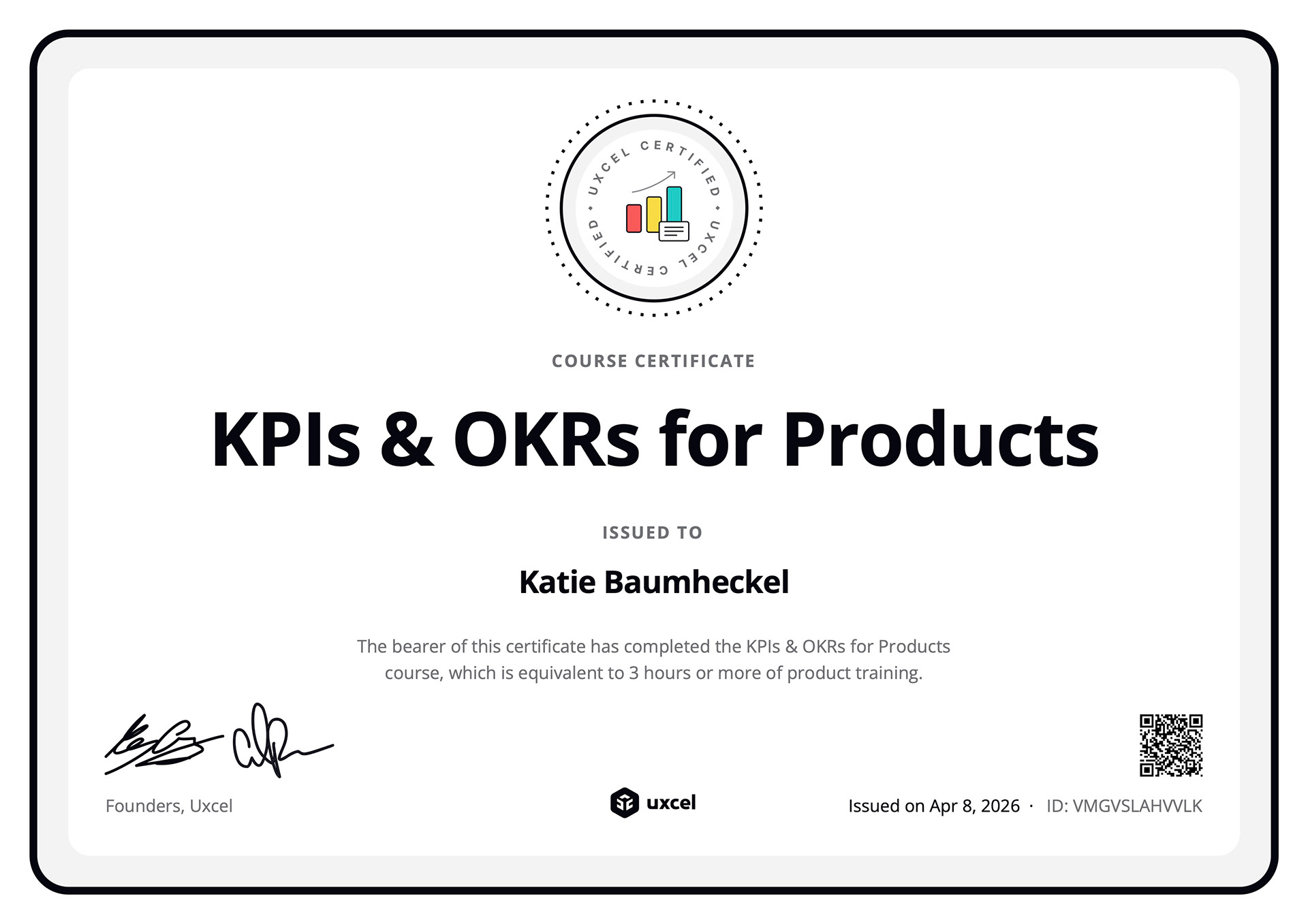
To solidify my approach to building metrics systems, I recently completed the KPIs & OKRs for Products certificate course through Uxcel. While it was a great refresher on foundational alignment, it also provided a sharp, structured framework for how data and product intuition should work together.
Here are the core takeaways and frameworks that continue to shape how I approach product measurement in my day-to-day practice:
1. Moving Beyond Vanity: Defining the North Star
Good metrics don't just track activity; they drive actionable decision-making. Frameworks like OKRs and KPIs are only as strong as the North Star Metric guiding them. In product design, it’s easy to fall into the trap of tracking superficial engagement—what the course highlights as the anatomy of "bad" metrics. Mastering the fundamentals means learning how to craft metrics that directly correlate with both user success and long-term business outcomes.
2. Cultivating True Data Literacy
Data is rarely self-explanatory. Developing confidence with data isn't just about reading a dashboard; it’s about asking better questions. When interpreting metrics during an audit or post-launch evaluation, asking why a metric moved is far more valuable than simply noting that it moved. Data literacy allows us to look past surface-level anomalies and uncover the real story behind user behavior.
3. Designing Holistic Measurement Systems (and Guardrails)
One of the most practical aspects of the course was its focus on designing comprehensive metric systems. A healthy product strategy doesn't rely on a single isolated metric. It accounts for:
• Bottleneck Metrics: Identifying friction points where users drop off or experience friction.
• Experimentation Metrics: Validating design hypotheses quickly and systematically.
• Guardrail Metrics: Protecting the overall user experience so that short-term optimization in one area
doesn't create dark patterns or erode long-term trust.
doesn't create dark patterns or erode long-term trust.
4. Operationalizing Metrics: Rituals & Alignment
A metric framework is useless if it sits in a siloed document. Translating theory into practice requires establishing team cadences, rituals, and clean communication channels. Whether aligning cross-functional stakeholders or setting up tooling and tech stacks for ongoing monitoring, data should serve as a shared language across design, engineering, and business teams.
Bringing It Back to the Practice
For me, the biggest takeaway comes back to the auditing process. Whenever you're tasked with building a measurement strategy for a product—especially from scratch—the goal isn't just to accumulate data points. The goal is to establish a clear line of sight between the user's experience and the business's definition of success.
Frameworks like KPIs and OKRs aren't rigid constraints; when applied intentionally, they give design decisions the clarity, credibility, and measurable impact they deserve.