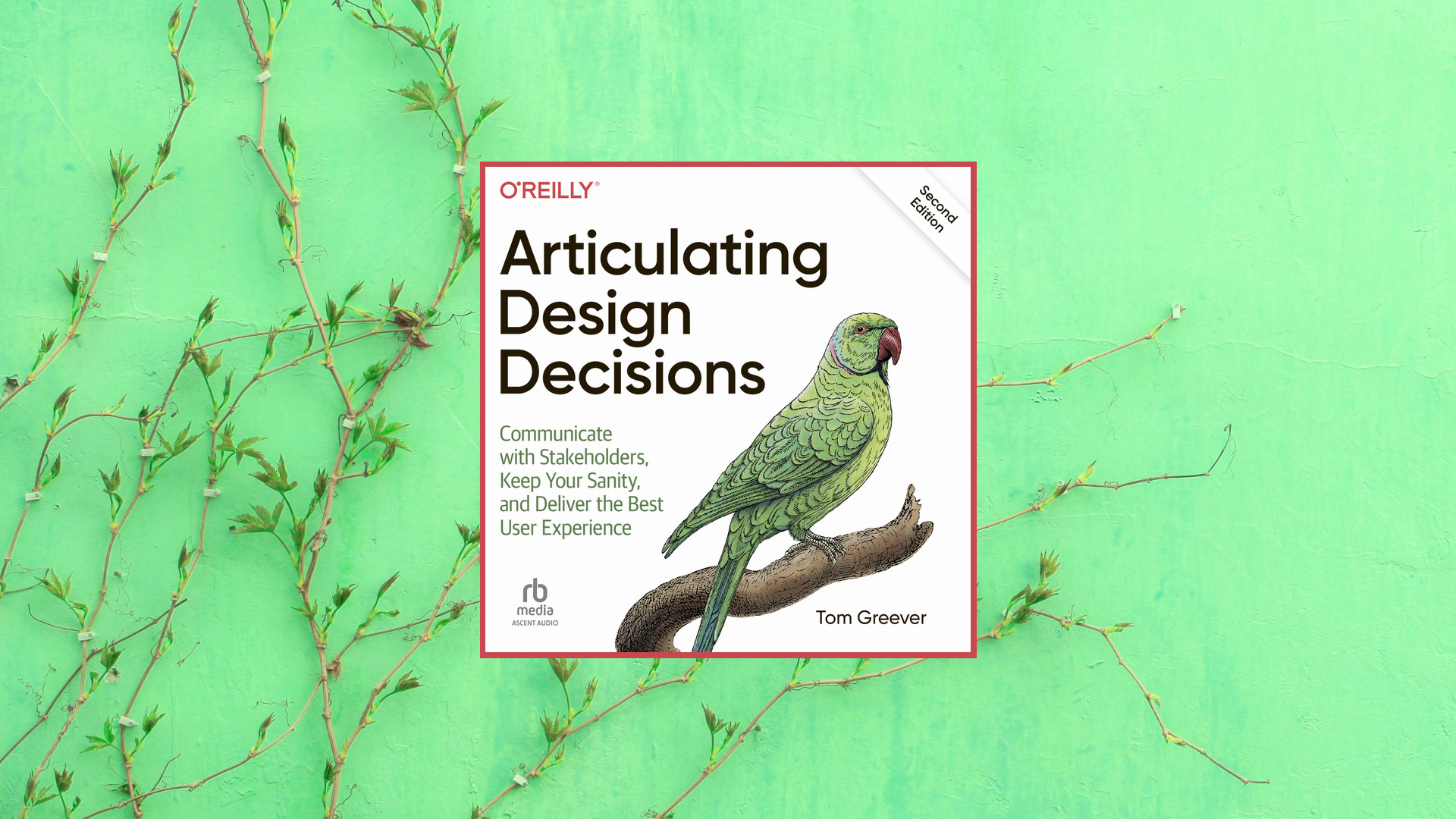
Articulating Design Decisions: What I Learned About Communicating as a Designer
I recently finished Articulating Design Decisions by Tom Greever, and it left me with a renewed appreciation for the part of design that happens outside the canvas or screen. The book is less about pushing pixels and more about the conversations, reasoning, and shared understanding that allow good design to actually succeed in the real world.
At its core, the book reinforces a simple truth:
Clear communication is just as critical as strong design craft.
As designers, we know how to create thoughtful solutions—but being able to articulate how and why we created them is what actually earns trust, influence, and alignment.
1. Being a great designer isn’t the whole job — you also have to communicate your HOW and WHY
Toward the end of the book, Greever shares a story about a coworker who was a brilliant designer but a terrible communicator. His lack of clarity created strain across the team and ultimately made collaboration harder than it needed to be. Greever realized he needed to step up as a leader by communicating more clearly and asking teammates directly what they needed from him.
That example reminded me that being a “hot-shot designer” with impeccable visual skills isn’t the full job description. Strong communication isn’t a bonus skill—it’s a core part of our responsibility. We owe it to our teams and stakeholders to make our thinking visible, to explain the rationale behind our decisions, and to bring others along with us.
2. Always tie design decisions back to the problem being solved
One theme Greever reinforces again and again is this:
When you anchor your work in the problem you’re solving, people are more likely to understand and support your decisions.
When you anchor your work in the problem you’re solving, people are more likely to understand and support your decisions.
It’s not about convincing through aesthetics.
It’s about connecting decisions to user needs, business goals, and clarity.
It’s about connecting decisions to user needs, business goals, and clarity.
He talks about how presenting your work this way not only builds trust, but also makes you more influential when navigating competing opinions. And when you can support your decisions with data, user insights, or research? Even better.
Because problem-solving is already central to how I approach both work and life, this idea flowed naturally for me. “Showing my work” in a more intentional way—tracing decisions back to problems and evidence—feels like an extension of how I already think. And it’s something I want to continually practice and refine.
3. Design is a second language — so ask better questions and leave room for people to respond
We’ve all been there: the vague feedback phase.
“Can you make it pop?”
“It feels off.”
“I don’t know what it needs… something.”
“Can you make that red?”
“It feels off.”
“I don’t know what it needs… something.”
“Can you make that red?”
Moments like these can feel confusing or frustrating, but Greever reframed them in a refreshing way. Instead of guessing, he encourages designers to ask more specific questions and invite more focused input. He also stresses that silence is not agreement.
One concept I especially appreciated was the idea of leaving space after a meeting for stakeholders to approach you privately. We don’t all process or speak up the same way, and giving someone a moment afterward might lead to the honest feedback they didn’t want to share in a larger group.
As someone who also needs time to internalize my thoughts—I’m not naturally a verbal processor—this idea really resonated with me. Making room for quieter voices isn’t just considerate; it helps the whole team reach better outcomes.
Setting clear windows for feedback is another tool I’m taking with me. Even a simple message like,
“Feel free to share any thoughts until Wednesday at 2pm so I can move forward,”
creates clarity and gives everyone a fair chance to weigh in without slowing the project.
“Feel free to share any thoughts until Wednesday at 2pm so I can move forward,”
creates clarity and gives everyone a fair chance to weigh in without slowing the project.
Final Thoughts
At the beginning of the book, Greever defines good design as solving a problem. With the influence of Don Norman’s Emotional Design, I’d personally expand that definition:
Good design solves a problem in a way that delights the user.

Overall, I’d rate this book a 4 out of 5.
It’s essential reading for designers navigating cross-functional conversations and the realities of stakeholder communication.
This book helped me connect those ideas more holistically. It reminded me that solving meaningful problems is only half the job. The other half is the ability to bring people along with you—to communicate thoughtfully, clearly, and with empathy.
Design lives in conversations, in shared language, in questions and clarifications, in moments where we take time to explain not just what we did, but why it matters.
If you’re a designer (or even someone who works with designers), this book is worth picking up. Whether you’re new to the field or years into it, the insights are a refreshing reminder of what it really means to design well:
Not just pixels, but people.
Not just solutions, but communication.